Uncategorized

Meet 1 Reflection

Now that you have the first Round Robin under your belt, we’d love to hear from you.

Did you have a favorite event? Did you see a particularly good P.A.R.T.Y. in a box performance? Do you have any good photos of the action you’d like to share?

Leave us a comment below and send your photos to usatstuff@gmail.com to get them into our photo gallery.

For Hosts and Facilitators

Ready, Set, Facilitate!

Even if you have been hosting Meets and facilitating events for years it can always be a little nerve-wracking to start a new season after so many months away. Here are some helpful tips to make this and every Meet run smoothly.

Being a Host

  • Double check all of your room reservations.
  • Ensure that you have the right staff on hand, which usually includes a janitor to unlock the rooms and help you troubleshoot.
  • Test your equipment. Make sure that whatever system you are using for oral Face-Off is working properly and you have the right number of computers (and maybe a back up) accounted for.
  • Make the proper signs. Do you have signs for the registration table, directional signs to help people get around and a set of team letters to help organize the P.A.R.T.Y. in a box material distribution?
  • Make sure you have everything you need for each Mind Sprint. Count out the materials in each MS to ensure there are no surprises for your facilitators.
  • Send reminders. You don’t want to be caught short a volunteer because it slipped someone’s mind.
  • Don’t forget to have your volunteers check competitions kits at the first Meet of the season.

Facilitating an Event

  • Read over your responsibilities in the Program Manual. It is a good idea to also be familiar with the Student Responsibilities as well.
  • Once you receive your materials, make sure to read over the instructions and devise the easiest and most consistent way to keep score. Are you going to use hash marks? Do you want to keep score on a separate piece of paper and transfer the final scores to the score sheet or write directly on it?
  • Remember, unless something is forbidden in the rules, it is more than likely okay. We want to encourage students to be creative!
  • Make sure you have a watch or cell phone handy to keep accurate time.
  • Be consistent! No team should gain an advantage over another by starting early, etc.
  • Watch for teams and individuals who exhibit exceptional creativity. We have a special Award Certificate for these people to honor ingenuity even if they don’t end up in first in place.

Have a wonderful time today and good luck!

For Coaches and Teachers, For Hosts and Facilitators, For Kids, Resources

Competition Kit Dos and Don’ts

The first Meet is just one week away, so it is time to think about getting the students prepared to compete. Whether or not you hold any practices before the season starts, it is important to make sure you competition kit is up to snuff. This may be the first time your competition is being used, or maybe your are dusting off the tried-and-true one from last year. Either way, there are certain things that are vital to every Meet.

Make sure that your competition kit is clearly labeled with your team’s school in case it gets misplaced. Kits should include only the following items, extra items will be discarded by facilitators.

1. Pencils- Kits may have up to 6 pencils, so make sure they are sharp and they have good erasers.

2. Markers or Bingo dabbers- Teams should have the following 8 colors available to them: red, blue, green, yellow, orange, purple, black and brown. Markers can dry out over time, so it is a good idea to test yours before each Meet. Kits may also contain up to 5 “day-glo” highlighter markers in addition to the regular markers or Bingo dabbers (these are slightly larger than markers and contain colored ink, which allows the artist to cover more area on a backdrop or piece of paper quickly, but harder to create fine detail).

3. Scratch paper- Each kit should contain a stack of scratch paper (fresh or recycled) up to 1/2 inch thick. Scratch paper is often used during Mind Sprints and Face-Off events.

4. Tape- Teams may have up to four rolls of tape in their kits, 2 clear “Scotch” tape style and 2 masking tape. The masking tape should be the standard buff color, not brightly colored painter’s tape.

5. Scissors- Kits should contain 2 pairs of regular paper scissors. Please, no fancy scissors that provide specially textured edges.

6. Dictionaries- Students are allowed to use up to two paperback dictionaries during each Meet. Some dictionaries contain extra information such as a table to help convert between different kinds of units, but these enriched dictionaries provide an unfair advantage and are not allowed.

7. Name tags- Team members must wear a name tag at all times during their Meet. Make sure you have name tags large enough to also include the team’s letter as assigned during registration (students receive stickers during registration). These can be single-use name tags that are discarded after every Meet, or more permanent ones such as those that pin on to clothing. Students are encouraged to decorate their name tags, but their name and Team number must be easily read by facilitators.

Items in the competition kit may be used throughout Face-Off and Mind Sprint events, and during P.A.R.T.Y. in a Box preparation, but they are not allowed during performances. For instance, students are not allowed to use materials from the kit as part of a prop that is used during the show. Tape may make an appearance in order to hang a back drop at the beginning of a performance before the timer starts timing, but it cannot be used to tie up a prisoner, etc during a performance.

And don’t forget, though it is not part of the competition kit each team is required to bring a lidded photo-copy paper box and any additional P.A.R.T.Y. items to the registration table before the Meet begins.

Team’s are encouraged to devise a team “uniform” to build solidarity, but this is not required. Clothing at Meets is limited to those things normally worn during the school day. As much fun as it might be to wear a cape or baseball hat, these items are not allowed during competition.

Good luck and have a great Meet!

For Coaches and Teachers, Mind Sprints, Resources, SCAMPER Technique

Getting the Most out of SCAMPER: R is for Rearrange

We’ve reached the end of our SCAMPER journey and I hope these posts have been helpful! If you missed any of the intervening letters, here are the links to the SCAMPER sheet that should be in every team’s competition kit and the posts about getting the most out of the technique:

S-C-A-M-P-E-R Sheet
Background on the technique

S is for Substitute

C is for Combine
A is for Adapt
M is for Magnify/Minify
P is for Put to Another Use
E is for Eliminate

Print-and-Cut-TangramAnd now for Rearrange. During the USAT season, the writers often employ at least one Mind Sprint where spatial awareness is key. Objects and ideas are flipped over or reversed, or the sequence of events may need to be changed in order to solve a problem. We ask students to use shapes and tools to copy images or to create their own pictures. Some students find this fun and easy, but for others it can be a real challenge.
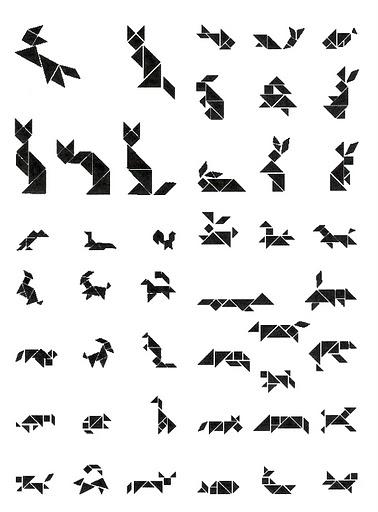
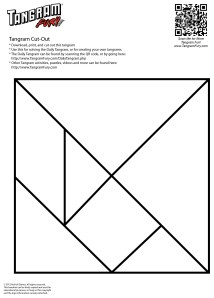
One way to tap into this skill is to try out a set of tangrams with your students. Tangrams are an ancient Chinese toy that gained popularity in Europe during the 1800’s. I had a set growing up and they are a lot of fun! With some imagination almost anything can be made by moving around these geometric shapes. Feel free to download and use both the tangram cut-out at left and the animal shapes at the end of the post.

Another way to hone rearranging skills is to use scrambled words. A day or two after teaching my ESL students new vocabulary words, I will often give them the words again but with the letters in the wrong order and ask them to figure out what the words are. For a native English speaker the exercise is mostly about moving the letters around in their minds and recognizing patterns, but it also helps my Bulgarian students learn to spell the words correctly. This is a fun game to play with your students, and it is quick and easy to prepare. Words can have a theme like foods, school subjects, toys, etc or they can be random to make it more challenging.

Likewise, you can scramble math problems. If a person is given the answer and all the components to a problem, she can use the order of operations to decipher the original equation. For instance, the answer is 49, the components are 3, 4, 7, ( ), + and x. What is the math problem?

Answer: (3+4)x7 = 49.

Happy SCAMPERing and good luck at the first Meet on December 12!

matematica-tangram_animais

For Coaches and Teachers, For Kids, For Parents, Resources, SCAMPER Technique

Getting the Most out of SCAMPER: E is for Eliminate

When employing “eliminate” in your brainstorms, one way to think about it is that you are reducing something to its most essential elements. If you take the sound system out of a car, is it still a car? Of course it is. But what about the engine? Your first reaction may be to think that the engine is essential, but I would make an argument that it is really its shape that makes a car a car. Think about cars from The Flintstones, or that kids pedal around their yards before they can ride a bike. These do not have engines, but what other label would you give them other than car? This exercise of stripping something down in order to define it is a great way to get kids to think about the world around them and come to recognize how things may be similar or different in various ways.

It can also help them to create their P.A.R.T.Y. in a Box performances, by helping them get to the heart of what  backdrops, costumes and props need in order represent something more complex. If they want to show a park, can they get by with just drawing a swing set? If they are going to make the audience believe they are carrying something heavy they don’t actually need a great weight, only a sac that looks full (and some good acting skills!).

The most straightforward way to use “eliminate” to get your students to stretch their brains is to start with something intact, and have them take turns eliminating elements and considering the consequences. This could be done systematically by first thinking of all the parts of a thing and then taking each out one by one. The more complex machine, organism or situation you begin with, the more opportunity there is to get rid of different elements, but you can always start simple and move to the more complex.

As I was writing this article I thought of a few prompts you could use with your students that all involve elimination. For instance, if you begin with an airplane and eliminate all the seats, would that lead to a more comfortable flight? Could they find a way to play with their electronic toys if the batteries are taken out? If someone loses their voice in the middle of an argument, what might happen? Or if a certain character was removed from a story, would it still have the same outcome?