Program Blog

Resources, STEM Education

USAT and STEM: US Science and Engineering Festival Resources

image via http://www.greeleyschools.org/Page/14442

When we first had the idea for this series, we had planned to write a different post for each of the STEM (Science, Technology, Engineering and Math) subjects. But, the more research we do into STEM initiatives, the more we see that this approach would be antithetical to the cause. The concept underlying STEM education is to give students the opportunity to do projects and ask questions that require more than one of these disciplines in order to answer them. You can use math to figure out how to answer a scientific question by engineering a piece of technology. for instance.

So rather than trying to tease out the individual subjects, we will be bringing you a series of resources to inspire our triathletes. In prior years, our program has mostly employed science and math in the Face-Off! round of each meet, but now you can expect to see more STEM appearing in Mind Sprints and P.A.R.T.Y. in a Box challenges as well. Alison Weaverdyck, our curriculum guru and head writer, has over 10 years experience working with kids in informal science settings, such as the Science Museum of Minnesota and the California Academy of Sciences in San Francisco, and she has exciting new ideas for bringing science to life for middle school students.

In the meantime, you should definitely take a look at some of the resources available through the federal government for making STEM subjects accessible for the next generation. In 2014, Washington DC hosted the largest gathering in US history, and it was all about celebrating science. We can’t hope to encapsulate the experience of the 650,000+ participants better than the video created for their website, which is below.

This website for the 2016 USA Science and Engineering Festival (which is unfortunately on the same date as the US Academic Triathlon state meet) is chock-full of short videos that draw on the mission of STEM education. Speakers knew they would be addressing an audience of young people and tailored their subject matter and level of complexity to be kid-accessible. For instance, future scientists can learn about the physics of super heroes, how the film Fantasia inspired one scientist to improve the world’s visual science vocabulary, and how engineering concepts go into Nike footwear.

Those videos are available here and on the festival’s YouTube channel.

For Coaches and Teachers, For Parents

Registration Reminder

This is just a friendly reminder that our registration deadline for the 2015-2016 season is Nov. 13.

USAT Registration 15-16– Download and fill out on your computer or print and fill out by hand. PDF registrations can be accepted via email (info@usacademictriathlon.com) or mailed to:

United States Academic Triathlon
2355 Fairview Ave N #335
Roseville MN, 55113

Excel 2015-16-web-registration-form– Download, fill out, save and send as an email attachment to info@usacademictriathlon.com.

Please note- we no longer have a fax number. Registration materials must be submitted by either mail or e-mail. If you have any questions, please call 651-489-9348 to talk to our Executive Director.

For Coaches and Teachers, For Parents, STEM Education

USAT and STEM: The Role of Creativity

If you are a parent or educator, you have probably heard the STEM (Science, Technology, Engineering, Mathematics) acronym thrown around a lot lately. This is due, in a large part, to studies that have shown a decline in interest in these subjects by American students. As a whole, our society will suffer from this trend as this generation enters adulthood without the tools to think critically and find ways to meet new challenges.

In response, federal and local governments, as well as independent philanthropic organizations, have implemented several measures and funding opportunities over the last few years. This takes the form of recruiting teachers trained in STEM fields, training existing teachers in best practices for integrating STEM into their classrooms, and funding for special projects that promote student interest in these intersecting fields.

At United States Academic Triathlon, we have always worked to provide our students with questions and challenges that span a variety of disciplines, including those represented by STEM. Over the next several weeks, this blog will feature posts that pertain to each of the four subjects, the ways the USAT addresses them, and creative ways to inspire students to embrace them.

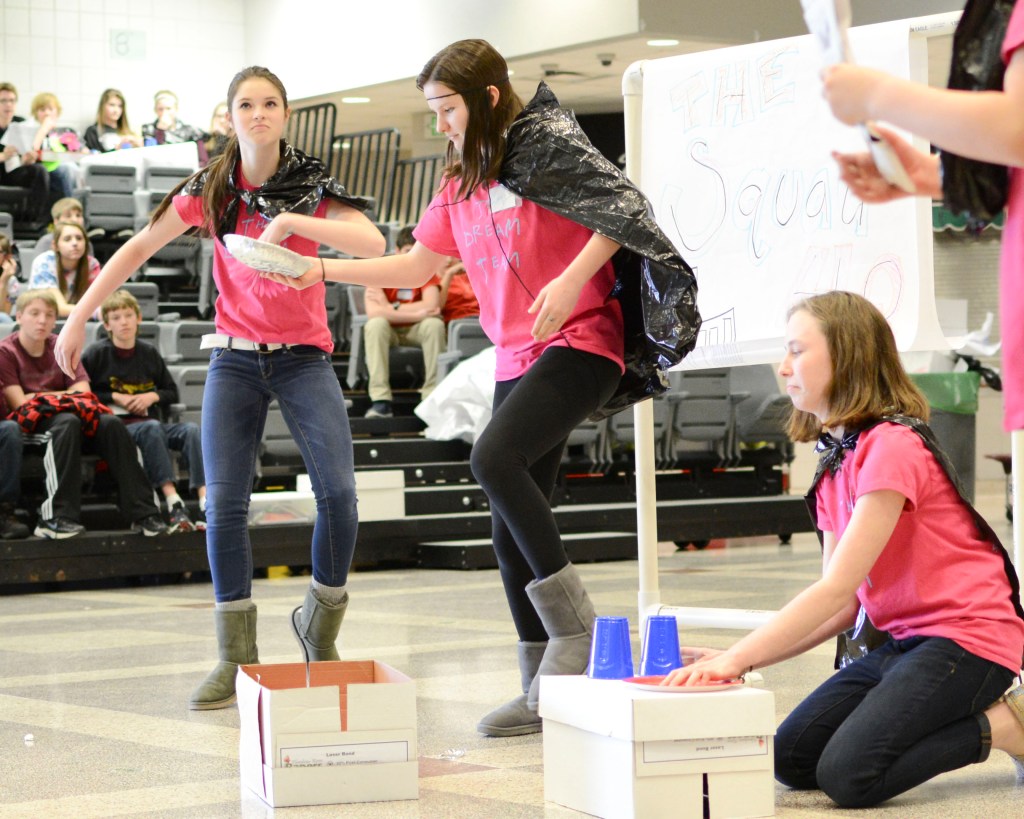
During the P.A.R.T.Y. in a Box portion of the competition, students are often asked to approach an old question in a new way, or think critically about the consequence of decisions
During the P.A.R.T.Y. in a Box portion of the competition, students are often asked to approach an old question in a new way, or think critically about the consequence of decisions.

No subject exists in a vacuum, and creativity is something that can enhance any endeavor. After all, computers can do complex calculations but they will never be “inspired” to do them. It is curiosity that drives us to ask questions and seek to understand our world and creativity that provides us with a means of applying tools such as mathematics and engineering. As a species, we have done a great job of answering many of the questions that confront us in our daily lives, but there is so much more to learn. The “way it has always been done” is not necessarily the “best” way, and what makes something better than something else is completely objective.

The pursuit of new and creative solutions can result in failure, but this does not negate the journey. Oftentimes, these “failures” turn out to be successes – they are simply the answer to a different question. For instance, when the glue commonly used in sticky notes was created, the people working on it were trying to create an extremely strong adhesive. When they “failed” to make something super sticky they opened the door to possibilities of impermanent adhesives, and just one application now sits in desk drawers all over the world.

As parents and educators, the best thing we can do for the next generation is to help them stay curious and creative. This can take many forms. We can help them to research the answer to a question they ask, encourage them to read for pleasure, make them turn off their electronic devices in favor of going out into the world, or play games that require imagination. At the beginning of a task, ask your children or students how they would solve a problem. Even if you feel like you know the “best” or “right” answer, ask them for their opinions even if they might be totally outside of the realm of possibilities (fix the broken pipe with peanut butter? Probably not).

This type of interaction encourages them to think constructively and creatively, and reinforces a sense that their ideas matter. Only after they feel confident in their ability to ask and answer questions can they use tools like the STEM disciplines to answer them.

For Coaches and Teachers, For Hosts and Facilitators

Starting a New USAT Team in a Few Easy Steps

With only one month left to register we wanted provide some information about how to start a new team if you are interested in coaching or if you have a child whom you think would enjoy the program but is not yet part of a team.

USAT_Pics40

Step 1: Identify 4-5 students, plus up to 2 alternates, in grades 5 through 8, to form a competition team. Students in grades 5 and 6 compete in the Challenger Division and grades 7 and 8 make up our X-Trainer Division.

It is fun to come up with a team name and, if funds are available, a team shirt/jersey for competitions! Some teams are made up students who are already friends, and some teams are created as a way to make new ones. It is a great experience for kids with a variety of talents and abilities. After all, there are many ways a person is gifted!

Step 2: Recruit another teacher or parent to serve as an additional coach or volunteer. Each team needs a Head Coach to successfully run a team, though additional coaches or adults (16 years or older) may be needed. Each team must provide at least one coach/volunteer to assist with the management of each Round Robin or Regional Meet.

Step 3: Register your team with the national US Academic Triathlon office by Nov. 13, 2015. Final payment is due by Dec. 1, 2015. To register, complete either the Xcel spreadsheet or the PDF registration forms on the Registration page. You can email or snail mail it to the contact information below:

US Academic Triathlon
2355 Fairview Ave N #335
Roseville MN, 55113
Email: info@USAcademicTriathlon.com

Step 4: Review the Program Manual, which will be sent electronically to first-time coaches upon successful registration, or can be downloaded here: Program Manual. Make sure you are familiar with all expectations of the Head Coach, additional coaches/volunteers, team members, and the competition process. During the course of your USAT season, you may be asked to host a meet at your school. The Program Manual and the Executive Director (Sarah Kirchner Sheldon) will be your essential resources for hosting your first USAT Meet.

Step 5: Create your team’s Competition Kit – this is your team’s box of essentials necessary to work through any problem thrown at them during a Meet. You can read more about the competition kit here.

Step 6: Practice! You can find practice problems on this site. For additional tips and practice ideas, follow us on Facebook.

Announcements, For Coaches and Teachers

You’re Invited to Advanced Coaches Training Oct. 17!

You are cordially invited to attend a complementary advanced coaches training hosted by US Academic Triathlon.

When: Saturday, October 17, 9-11 a.m.
Where: Cottage Grove Middle School Media Center
9775 Indian Blvd S, Cottage Grove MN 55016

We will cover such topics as general coaching best practices, practice techniques, and sample Meet activities. This training will benefit both new and seasoned coaches, coordinators, and Host/Facilitators.
Please RSVP by 5 p.m. Thursday, October 15 to me via email (sarah@usacademictriathlon.com) with the name and school/district of each coach who will be in attendance. If you have questions, feel free to email or call 651-489-9348.
Next year we are hoping to do multiple training sessions in different parts of the state, so if you can’t make it this year keep your eyes peeled for next fall.
We look forward to seeing you there next Saturday!