
We have added a special page to this site with the information you need if you are participating in the State Meet on February 28. Congratulations to teams who qualified!
Visit the State 2015 Page.
We have added a special page to this site with the information you need if you are participating in the State Meet on February 28. Congratulations to teams who qualified!
Visit the State 2015 Page.
Just like a character’s costume, the props they use can make people with certain occupations easily recognizable. A person wearing a tie is some kind of professional, a person with a tie AND a clipboard is probably an inspector. A person wearing a baseball hat could just be a fan, but if they are also carrying a glove or bat, that will do even more to make identification by the audience possible.
In some cases, the right prop can also replace a costume. But, if this is your team’s approach, that should also mean that props get enough attention. If you are going to use a single object to tell us everything we need to know about a character, you had better make it a good object. Here a few examples of props that can help you tell the story, even if there is no costume to aid you.
1. Wands- witches, wizards, fairy godmothers and the like all carry these magical sticks. Oftentimes, teams get drinking straws in their boxes, which can serve as a basis for a wand. But don’t just point a straw at your foes, make sure to add something like a star to the end, or have another person throwing bits of paper to show that magic is coming out of it.
2. Scrolls- Some prompts explicitly call for a narrator, but really you can add this pseudo-character to any story. One benefit is that they do not necessarily need a costume, but they do a lot to tell the story and keep it on track. If you do have a narrator, give them a scroll with the script or even just an outline of the skit so they can keep the action moving if someone drops a line, or make sure to keep important parts from being left out by mistake. A bard, herald, or even a royal cook on her way tot he market in the Medieval age could carry scroll as well.
3. Weapons- There is no official policy against violence in the P.A.R.T.Y. performances, but in general we have found that judges respond better to humor than to drama or violence. But, that doesn’t mean that weapons can’t be employed to help tell your story. Even without any armor, a person carrying a broadsword is probably a knight. Maybe your cowboy doesn’t have a ten-gallon hat, but he does have a six-shooter that he pulls on the bad guy. I wouldn’t be surprised to see an alien who carries a ray gun, either.
Another interesting thing I noticed in my own USAT days, as well as during judging, is that oftentimes the idea for the answer to the prompt comes from the materials available. More than once I have seen multiple teams decide to have a wizard in their skit because there was already something that looked like a wand in their box. On one hand, this is a good thing and they were able to make a quick decision and execute it. On the other hand, the three similar skits blended together in the minds of the judges, which made it harder to judge them individually and made them seem less creative than they really were.
To be safe from this problem and to get noticed, it is a good strategy to alter any object at least in some way before using it in a skit. If the long, shiny thing just screams “wand” at you, at least make the handle longer or have it make a silly noise when you’re using it. In general, seeing something used for something other than its intended purpose will be more memorable, and so be more likely to earn you more points. For instance, it is much more interesting to see a milk carton as a hat than to see it being used to pour imaginary milk.
My own teams never made it to State, but we sure had a lot of fun! But, for some teams, the competitive aspect of USAT is part of the experience and enjoyment of participating. For my final installment of this series, I will be posting P.A.R.T.Y. in a Box Time: Close Reading in order to give some tips about maximizing points during this round of the competition.
 People spend a lot of time thinking about their own appearance. We wear make-up, iron our shirts, match our socks and do all sorts of things ranging from meticulous to menial when it comes to how we look. Humans make snap judgements based on how someone is dressed all the time, and there are ways for students to tap into this and use it for their own benefit during a P.A.R.T.Y. skit.
If you have ever watched these short plays, you will have seen at least one student put arm and head holes into a garbage bag and wear it as a costume. The opaque trash bags certainly cover a student’s street clothes, but it doesn’t really do anything to inform the audience about who they are supposed to be seeing instead. This is where accessories become indispensable. With only a short time to prepare the skit and a short time to perform it, teams can’t afford to leave the judges guessing. There are many small, easy to make pieces that can be added to costumes in order to inform and delight the audience. And don’t forget, there is no rule that says the backdrop paper can’t be used in your costumes.
1. Ties. Making an entire suit for a character would take a long time, but there are many people who become much more recognizable if they are wearing this kind of formal attire. Lawyers, business people, generic “dad” characters, etc could all be delineated by adding a tie. You can add further interest by making the tie colorful or dull, patterned or plain, crumpled or immaculate. And there are, of course, many different shapes for ties. Most people would see a bow tie and go straight to scientist (thanks to Bill Nye, the Science Guy), or within a line or two this person would be easily recognizable as The Doctor from Doctor Who. A cravat or bolo tie would paint a totally different picture.
2. Head gear. When you enter a room looking for a king, what would you expect to see? Well, a crown of course! Hats are another accessory that can do a lot to define your character and don’t have to take long to make, though a very elaborate hat will definitely get the attention of your judges. You can use head gear to show someone’s job. For instance, football players, motorcycle drivers and stunt people all wear helmets. You can also use hats to quickly tell your audience where they are in time. In the 1940s, no one would be caught dead without their fedora, for example.
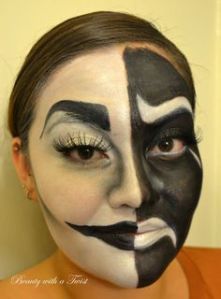
3. Masks. Totally covering the face can be tricky because it could be hard for the judges to see your emotions, but in the case of becoming something other than human, a mask can be invaluable. Want your alien to be more alien? Give it a green face! Does your story involve a pack of wolves? A mask would be a quick and easy way to give your wolves ears and fur without having a full body costume. Masks can be held in front of the face, or held on by a strap made from paper and tape.
4. Anything worn on the torso. The audience and judges will mostly be focused on the faces of the actors, and the next biggest space near the face is the torso. Even if you don’t have the right pants or shoes, decorating the torso of your character goes a long way to informing your audience. The epaulettes of a general, or instance, go on the shoulders, and a few metals on the chest would make it easy to recognize that this person is in the military. Even if your sheriff is missing his hat, a yellow star on the chest will tell the audience they are looking at the law in these parts. Even an over-sized “Hi, my name is …” badge can add characterization, and often humor, to a skit.
5. Belts. Like hats, belts can tell you about a person’s job. Plumbers, handymen, construction workers, even Batman, have distinctive belts that can be recreated in paper. Add a couple plastic cups and you’ve even got a place to store paper wrenches and screw drivers.
6. Don’t forget the box! Besides the backdrop paper, another building material that teams often overlook is the box that contains their P.A.R.T.Y. supplies. This cardboard is much more valuable as component of a costume or prop than it is to make it easy to carry your stuff! Cardboard is rigid, so it can give the appearance of armor for a samurai or knight. It can add bulk to a strongman in a carnival, or be the basis for comically large clown shoes. This is one of the materials you can always count on getting in a Meet, so why not practice changing it into costume components?
Do you have other good ideas for adding distinctive accessories to costumes? Please leave us a comment by clicking the link below the title!
Next week, check out PA.R.T.Y. in Box Time: Props add Pop for more ideas!
Wow! This condensed season is just flying by. The Round Robin competitions are now over (unless you were one of those unfortunate districts caught in the January 9th inclement weather, that is) and we’d love to hear from you about this or any Meet so far this season.
Have you noticed any differences from last year to this year? Are the weekly articles on this blog helping you and your team? Did any of the events stand out to you? Do you have any pictures to share?
Leave us a comment by clicking the link above, or send pictures to usatstuff@gmail.com!
The materials that teams get for each P.A.R.T.Y. challenge vary, but one thing that they always get is a large piece of butcher paper for making a backdrop. Some prompts or stories may only call for a single setting, while others require to characters to move between locales. Oftentimes the backdrop is left to the last few minutes of prep time and the scenery is just an afterthought, but there are lots of creative ways to get the most out of that paper and add something special to a skit. So here are some tips for getting the most out of a backdrop.
 usacademictriathlon.com