For Coaches and Teachers, For Parents, Resources, STEM Education

USAT and STEM: The Role of Museums

Getting kids excited about Science, Technology, Engineering, and Math can take many forms. They get a certain type of exposure to these subjects in school, but museums also offer great opportunities to explore these principles in a different setting and on a different scale. When kids interact with objects, be they the original things or exhibits that present their mechanisms, they can’t help but learn by doing. And these are the experiences that adults still remember long after their middle school years have passed. (If you would like to learn more about the impact of science centers on learning and personal growth, you should check out this meta study.)

In Minnesota alone there are several science and technology-based museums. The Bell Museum of Natural History on the University of Minnesota campus, for instance, is a place for kids to learn about animals through dioramas and hands-on exploration of fossils. The Mill City Museum explores the history of industry on the Mississippi waterfront. You have probably never heard of the Bakken Museum, but it is a unique way to discover the power and uses of electricity and magnetism. The Works Museum in Bloomington is dedicated to the inner workings of machines and engineering, and the Minnesota Transportation Museum in St Paul is dedicated to the technology of getting from point A to point B. Of course, there is always the Science Museum of Minnesota as well.

“I would definitely say that the Science Museum of Minnesota (SMM) played a big role in my interest in science later in life. I had a great time visiting both the old building and the renovated one, so when I was looking for an out-of-the-box job for my final year of undergrad the SMM seemed like a perfect fit. I not only got to work in the Collections Department and the Big Backyard, but took some of the free classes they offered. I will never forget when I was first introduced to the concept of computer coding by learning how to write a simple program that turned LED lights on and off in the order I wanted. It turns out that coding is both easy and fun, and now there are so many different applications across diverse platforms. The possibilities for expanding this kind of technology are endless.”

~Alison Weaverdyck, Creative Director

And the best part is that the SMM still offers a variety of free classes for kids of all ages! This weekend the fabulous staff, as well as female scientists from around the state, will be celebrating women in science with their “Girls, Science and Technology” day. The demonstrations below are included in the admission price, but for one day only museum patrons can get FREE admission for up to four kids with the purchase of one adult ticket. Find out more on their website (link to embed: https://www.smm.org/girls-science-and-technology).

On Saturday, November 14 from 10-4 you are invited to:

  • Learn how lungs work with ventilated pig lungs
  • Explore mathematics and learn how to calculate probability and percentages
  • Manipulate medical guidewires and stylets through human anatomy models
  • Bring magic to life with sensors and 3D printers, and learn how sensors improve and assist with our lives on a daily basis
  • Explore the properties of air with hands-on windbag activity
  • Touch real pig hearts and learn about the wild world of the heart
  • Play dentist and apply sealants to plastic teeth models
  • Create your own hoop glider and fly it down a runway
  • Discover what’s inside your mouth with intra-oral cameras
  • Learn about the mechanics and technology of robots with FIRST Tech Challenge
  • Find out what it’s like to do a weather forecast on the Fox 9 Green Screen

Looking to infuse your USAT practice with a little technology but don’t have time to take a field trip to a museum? Here are a few brainstorming and project ideas to get your triathletes in the right mindset.

  • Name things with batteries. If the batteries are removed, what else can be done with these items? Can they be taken apart and the components used for something new?
  • What are games that you play on a computer or smart phone? Do you play any games that are also available in another format, such as Scrabble? Which method do you prefer and why?
  • What are some things that computers can do that people can’t? What are things that people can do that computers can’t?
  • Choose an item of technology that students would use regularly, and ask them to research different components. For instance, we all ride in cars all the time, but how did we end up with rubber tires? What is anti-freeze made of? Do hubcaps serve a purpose?



Resources, STEM Education

USAT and STEM: US Science and Engineering Festival Resources

image via http://www.greeleyschools.org/Page/14442

When we first had the idea for this series, we had planned to write a different post for each of the STEM (Science, Technology, Engineering and Math) subjects. But, the more research we do into STEM initiatives, the more we see that this approach would be antithetical to the cause. The concept underlying STEM education is to give students the opportunity to do projects and ask questions that require more than one of these disciplines in order to answer them. You can use math to figure out how to answer a scientific question by engineering a piece of technology. for instance.

So rather than trying to tease out the individual subjects, we will be bringing you a series of resources to inspire our triathletes. In prior years, our program has mostly employed science and math in the Face-Off! round of each meet, but now you can expect to see more STEM appearing in Mind Sprints and P.A.R.T.Y. in a Box challenges as well. Alison Weaverdyck, our curriculum guru and head writer, has over 10 years experience working with kids in informal science settings, such as the Science Museum of Minnesota and the California Academy of Sciences in San Francisco, and she has exciting new ideas for bringing science to life for middle school students.

In the meantime, you should definitely take a look at some of the resources available through the federal government for making STEM subjects accessible for the next generation. In 2014, Washington DC hosted the largest gathering in US history, and it was all about celebrating science. We can’t hope to encapsulate the experience of the 650,000+ participants better than the video created for their website, which is below.

This website for the 2016 USA Science and Engineering Festival (which is unfortunately on the same date as the US Academic Triathlon state meet) is chock-full of short videos that draw on the mission of STEM education. Speakers knew they would be addressing an audience of young people and tailored their subject matter and level of complexity to be kid-accessible. For instance, future scientists can learn about the physics of super heroes, how the film Fantasia inspired one scientist to improve the world’s visual science vocabulary, and how engineering concepts go into Nike footwear.

Those videos are available here and on the festival’s YouTube channel.

For Coaches and Teachers, For Parents

Registration Reminder

This is just a friendly reminder that our registration deadline for the 2015-2016 season is Nov. 13.

USAT Registration 15-16– Download and fill out on your computer or print and fill out by hand. PDF registrations can be accepted via email (info@usacademictriathlon.com) or mailed to:

United States Academic Triathlon
2355 Fairview Ave N #335
Roseville MN, 55113

Excel 2015-16-web-registration-form– Download, fill out, save and send as an email attachment to info@usacademictriathlon.com.

Please note- we no longer have a fax number. Registration materials must be submitted by either mail or e-mail. If you have any questions, please call 651-489-9348 to talk to our Executive Director.

For Coaches and Teachers, For Parents, STEM Education

USAT and STEM: The Role of Creativity

If you are a parent or educator, you have probably heard the STEM (Science, Technology, Engineering, Mathematics) acronym thrown around a lot lately. This is due, in a large part, to studies that have shown a decline in interest in these subjects by American students. As a whole, our society will suffer from this trend as this generation enters adulthood without the tools to think critically and find ways to meet new challenges.

In response, federal and local governments, as well as independent philanthropic organizations, have implemented several measures and funding opportunities over the last few years. This takes the form of recruiting teachers trained in STEM fields, training existing teachers in best practices for integrating STEM into their classrooms, and funding for special projects that promote student interest in these intersecting fields.

At United States Academic Triathlon, we have always worked to provide our students with questions and challenges that span a variety of disciplines, including those represented by STEM. Over the next several weeks, this blog will feature posts that pertain to each of the four subjects, the ways the USAT addresses them, and creative ways to inspire students to embrace them.

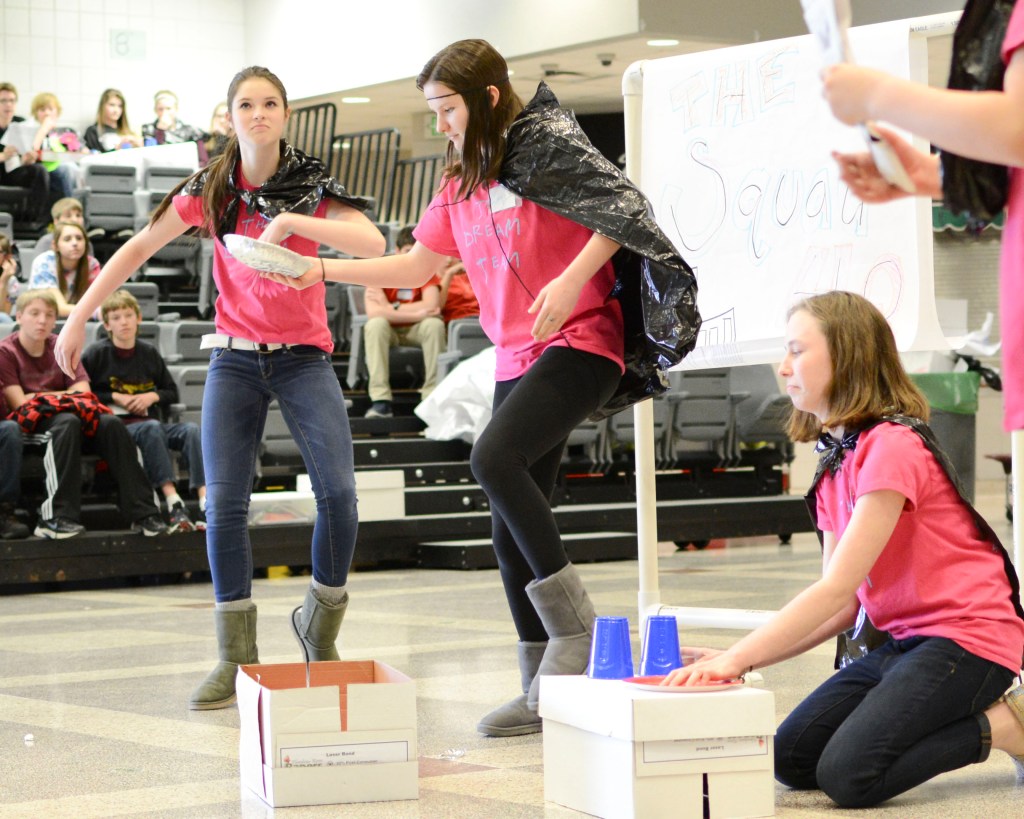
During the P.A.R.T.Y. in a Box portion of the competition, students are often asked to approach an old question in a new way, or think critically about the consequence of decisions
During the P.A.R.T.Y. in a Box portion of the competition, students are often asked to approach an old question in a new way, or think critically about the consequence of decisions.

No subject exists in a vacuum, and creativity is something that can enhance any endeavor. After all, computers can do complex calculations but they will never be “inspired” to do them. It is curiosity that drives us to ask questions and seek to understand our world and creativity that provides us with a means of applying tools such as mathematics and engineering. As a species, we have done a great job of answering many of the questions that confront us in our daily lives, but there is so much more to learn. The “way it has always been done” is not necessarily the “best” way, and what makes something better than something else is completely objective.

The pursuit of new and creative solutions can result in failure, but this does not negate the journey. Oftentimes, these “failures” turn out to be successes – they are simply the answer to a different question. For instance, when the glue commonly used in sticky notes was created, the people working on it were trying to create an extremely strong adhesive. When they “failed” to make something super sticky they opened the door to possibilities of impermanent adhesives, and just one application now sits in desk drawers all over the world.

As parents and educators, the best thing we can do for the next generation is to help them stay curious and creative. This can take many forms. We can help them to research the answer to a question they ask, encourage them to read for pleasure, make them turn off their electronic devices in favor of going out into the world, or play games that require imagination. At the beginning of a task, ask your children or students how they would solve a problem. Even if you feel like you know the “best” or “right” answer, ask them for their opinions even if they might be totally outside of the realm of possibilities (fix the broken pipe with peanut butter? Probably not).

This type of interaction encourages them to think constructively and creatively, and reinforces a sense that their ideas matter. Only after they feel confident in their ability to ask and answer questions can they use tools like the STEM disciplines to answer them.

For Coaches and Teachers, For Hosts and Facilitators

Starting a New USAT Team in a Few Easy Steps

With only one month left to register we wanted provide some information about how to start a new team if you are interested in coaching or if you have a child whom you think would enjoy the program but is not yet part of a team.

USAT_Pics40

Step 1: Identify 4-5 students, plus up to 2 alternates, in grades 5 through 8, to form a competition team. Students in grades 5 and 6 compete in the Challenger Division and grades 7 and 8 make up our X-Trainer Division.

It is fun to come up with a team name and, if funds are available, a team shirt/jersey for competitions! Some teams are made up students who are already friends, and some teams are created as a way to make new ones. It is a great experience for kids with a variety of talents and abilities. After all, there are many ways a person is gifted!

Step 2: Recruit another teacher or parent to serve as an additional coach or volunteer. Each team needs a Head Coach to successfully run a team, though additional coaches or adults (16 years or older) may be needed. Each team must provide at least one coach/volunteer to assist with the management of each Round Robin or Regional Meet.

Step 3: Register your team with the national US Academic Triathlon office by Nov. 13, 2015. Final payment is due by Dec. 1, 2015. To register, complete either the Xcel spreadsheet or the PDF registration forms on the Registration page. You can email or snail mail it to the contact information below:

US Academic Triathlon
2355 Fairview Ave N #335
Roseville MN, 55113
Email: info@USAcademicTriathlon.com

Step 4: Review the Program Manual, which will be sent electronically to first-time coaches upon successful registration, or can be downloaded here: Program Manual. Make sure you are familiar with all expectations of the Head Coach, additional coaches/volunteers, team members, and the competition process. During the course of your USAT season, you may be asked to host a meet at your school. The Program Manual and the Executive Director (Sarah Kirchner Sheldon) will be your essential resources for hosting your first USAT Meet.

Step 5: Create your team’s Competition Kit – this is your team’s box of essentials necessary to work through any problem thrown at them during a Meet. You can read more about the competition kit here.

Step 6: Practice! You can find practice problems on this site. For additional tips and practice ideas, follow us on Facebook.