Wow! This condensed season is just flying by. The Round Robin competitions are now over (unless you were one of those unfortunate districts caught in the January 9th inclement weather, that is) and we’d love to hear from you about this or any Meet so far this season.
Have you noticed any differences from last year to this year? Are the weekly articles on this blog helping you and your team? Did any of the events stand out to you? Do you have any pictures to share?
Leave us a comment by clicking the link above, or send pictures to usatstuff@gmail.com!
The materials that teams get for each P.A.R.T.Y. challenge vary, but one thing that they always get is a large piece of butcher paper for making a backdrop. Some prompts or stories may only call for a single setting, while others require to characters to move between locales. Oftentimes the backdrop is left to the last few minutes of prep time and the scenery is just an afterthought, but there are lots of creative ways to get the most out of that paper and add something special to a skit. So here are some tips for getting the most out of a backdrop.
The appearance of the backdrops counts as 10 points of the overall score for the skit, so don’t overlook the opportunity to get more points by doing something sloppy or unrecognizable.
Did you know that the paper is large enough that if students use both sides they can easily show up to four different locations? But, transitioning between them can be tricky. Most of the time, the paper is draped over the top of the backdrop holder. It can be taped in place to ensure it doesn’t fall during a show, but most teams rely on gravity to keep it in place. But, depending on how many times the characters need to change location this can be a dicey proposition, and a backdrop that falls down in the middle of a show is distracting for the audience and the performers. Tape from the competition kit cannot be used during the skit, but it can be used during set up.
In order to change between backdrops, students can turn the entire backdrop holder around rather than trying to “turn the page” by moving the paper itself. This can save time and hassle, but they also need to make sure they leave themselves enough space between their extra team members and any props or costumes they are saving for later and the backdrop holder as they move it.
One clever way to use the paper is to cut a “window” into the paper and have a character stand behind it. I was in a skit once where we had “breaking news” on a television and we used a window we cut into the paper as the television screen. Maybe the characters go through a drive-thru window at a fast food restaurant, or they step through a door to another world. There are lots of ways to incorporate this trick and add interest to a show.
There is no rule that says the paper must remain intact. Backdrops can take any shape your students can imagine, and the paper can be used in costumes and props if the need arises.
Time is of the essence, so consider dividing the labor during the PA.R.T.Y. prep time. If some people are better at drawing you might consider putting them on backdrop duty rather than working on it all together.
When considering the limited time available, it is also a smart strategy to get good at identifying the minimum elements needed to convey a certain place or time. If the story takes place in the future, a hover car in the sky can go a long way to situating your story in time. If there is a scene in a classroom a desk with an apple on it is a good way to simply show that setting. This corresponds to the E (Eliminate) of the SCAMPER technique.
That’s two Round Robins down and only one to go! We’d love to hear from you about our second Meet of the season.
Did any students display a special or surprising talent? Did you get a kick out of any of challenges? Were there items on the Face-Off that even stumped the parents?
Leave us a comment by clicking “Leave a Comment” below the title of this post and send your photos to usatstuff@gmail.com to get them into our upcoming photo gallery.
US Academic Triathlon participants often compete against as many as eight other teams during a Meet, and they all have the same P.A.R.T.Y. in a Box prompts. It is up to the students to find ways to stand out and get noticed by the judges. Some judges use the first show they see to set a bar for all of the performances while others give preliminary scores and go back to adjust them after they’ve seen all of the shows. But no matter the style of the people on the panel that Meet, if the show is forgettable the scores will be lower.
Many of the prompts explicitly require the teams to showcase someone’s special skill as a part of their P.A.R.T.Y. solutions, but this is a good way to approach all of the challenges. Can anyone do funny impressions? Is there a juggler in the house? What about walking on one’s hands? There are lots of quirky little things that teams can share with their audience (and the judges), to make a show memorable.
Adding music is another great way to garner favor with the spectators. You don’t have to be a “good” singer to have a song make an impact. It can be a vehicle for moving the plot forward, a way to keep the audience busy during a scene change, or a mode of adding interest to a character. It is also an especially good way to build comedy into a show. Taking a song that people know and changing the lyrics in a clever way will almost always illicit chuckles. This is something that comes easily to some people, but it is also a skill that can be practiced.
It is also very important not to be remembered for the WRONG reasons. Having poor theater etiquette when it isn’t their turn or dissolving into giggles during a performance are both ways of making an impression on the judges, but in negative ways. Breaking the rules is another bad way to get noticed and the reputation can follow a team throughout a season. I was a judge during a performance once where they built their entire skit around a shirt that one of the students was wearing.
This is, of course, unfair to the other teams who were not provided with that shirt as part of their materials, and the other judges on the panel took it almost personally. In that case we decided that it was an innocent mistake and took off only 5 points from their overall raw score, but depending on the infraction a team could lose much more. And I can say from that experience it was difficult to judge the rest of their skit separate from the “cheating issue”, and I am sure that they received a lower overall score as a result. The skits are the responsibility of the students, but coaches should also make sure they understand the rules to avoid any inadvertent loss of points.
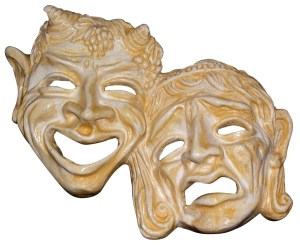
Acting effectively on a stage requires a special set of skills. Most of the time if we are watching actors they are on television or a movie screen and their faces are always perfectly framed. No matter if they are whispering or shouting, the audience can always hear exactly what is being said. But, being in front of a real audience without the benefits of a microphone or a cameraman is another matter completely.
Stage actors must have an awareness of where they are in relation to the audience at all times. All too often I have seen P.A.R.T.Y. skits with a good story get muddled because the actors turn their backs to the spectators. No matter how good the acting, it is wasted if the audience can’t see the actor’s faces. In a real conversation people usually face each other, but during a play the regular rules don’t apply.
Actors must remember to “cheat out” and angle their bodies so members of the audience can see everything they do. Whenever I take the stage I pretend someone is trying to sneak up behind me from the wings (the technical term for the areas beside the stage), so I make sure I can see off stage from my peripheral vision. This keeps the shoulders turned squarely to the front and most of the body open to the audience. All of the action of the show must be directed at the spectators even if it feels unnatural.
During P.A.R.T.Y. in a Box performances, teams should be provided with a minimum of 8×10 feet area in which to perform, but often get even more space. While doing their performances, students should endeavor to “fill” whatever space they get by ensuring the characters move around the stage. Oftentimes teams end up “stuck” to the backdrop holder which can end up functioning like a security blanket. The audience (and judges) will be much more engaged by a show that features people moving confidently around the stage. It is also possible through movement and props to delineate separate settings on a single stage, so if the action is occurring stage left, stage right is free to be prepared for the next change of location or scenery.
But, being seen is only half the battle– actors must also be heard. Fear of public speaking (glossophobia) is the most commonly reported phobia of them all. When a person is nervous their throats begin to constrict and it can be very difficult to get the words out. This is one reason that professional actors always engage in warm-up activities before a performance. These release tension and stretch muscles in the throat and the rest of the body in order to facilitate locution. Tongue twisters are a great way to get the lips and tongue ready for a performance, and ensure the throat muscles are relaxed enough to carry a voice to the back row and beyond.
Below are some of my favorite tongue twisters that I picked up in acting classes over the years. Speed is less important than precise pronunciation when it comes to using them to warm-up before a performance, but challenging students to race each other or beat a set time adds another dimension of challenge. They are also just plain fun to say and even making mistakes usually results in giggling so they are a nice way to break tension.
1. Unique New York, unique New York, you know you need unique New York
2. The sixth sick sheik’s sixth sheep’s sick.
3. The teeth, the lips, the tip of the tongue,
The tip of the tongue, the teeth and the lips (x3)
4. I sit in solemn silence
on a dull, dark dock
in a pestilential prison
with a lifelong lock
awaiting the sensation
of a short, sharp shock
from a cheap and chippy chopper
on a big, black block
5. About Socks (Dr. Seuss)
Give me the gift of a grip-top sock,
A clip drape shipshape tip top sock.
Not your spinslick slapstick slipshod stock,
But a plastic, elastic grip-top sock.
None of your fantastic slack swap slop
From a slap dash flash cash haberdash shop.
Not a knick knack knitlock knockneed knickerbocker sock
With a mock-shot blob-mottled trick-ticker top clock.
Not a supersheet seersucker ruck sack sock,
Not a spot-speckled frog-freckled cheap sheik’s sock
Off a hodge-podge moss-blotched scotch-botched block.
Nothing slipshod drip drop flip flop or glip glop
Tip me to a tip top grip top sock.
Do you know any great tongue twisters you’d like to share? Please leave a comment!

 usacademictriathlon.com