
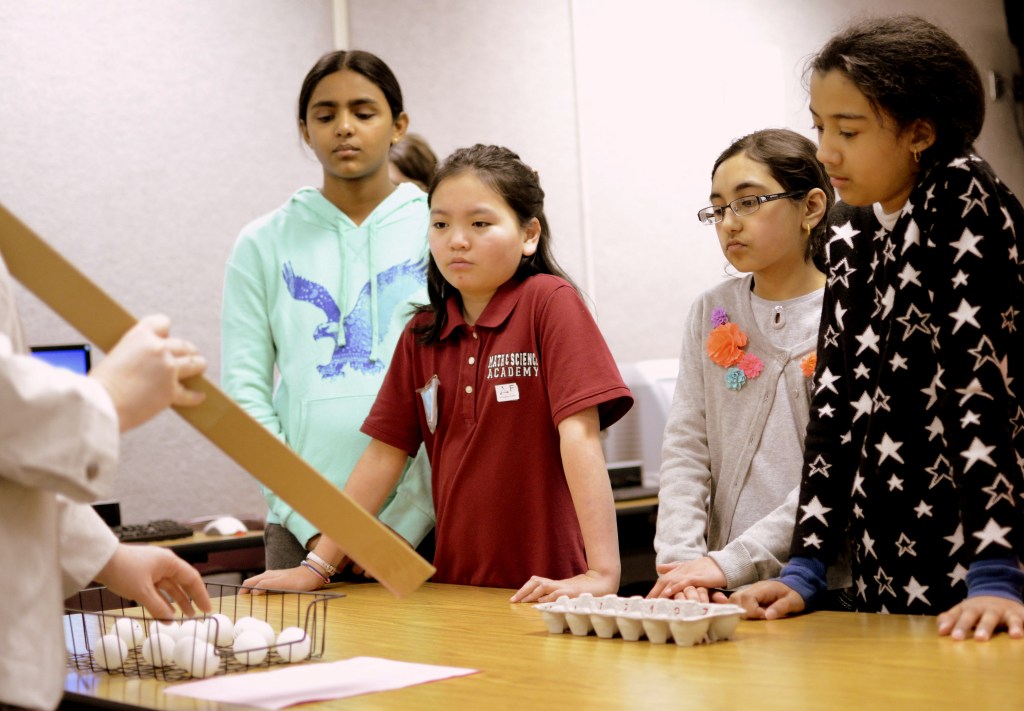
SCAMPER is a valuable technique for students as they approach USAT challenges. Below are links to last year’s SCAMPER blog series for new students and coaches, as well as those returning who might need a refresher or a way to liven up practices.
SCAMPER is a valuable technique for students as they approach USAT challenges. Below are links to last year’s SCAMPER blog series for new students and coaches, as well as those returning who might need a refresher or a way to liven up practices.

Now that you have the first Round Robin under your belt, we’d love to hear from you!
Did you have a favorite event? Did you see a particularly good P.A.R.T.Y. in a box performance? Do you have any good photos of the action you’d like to share?
Leave us a comment below or on our Facebook page, and send your photos to Alison@usacademictriathlon.com if you’d like to see them on the website or Facebook.
Next week you won’t see any posts on the blog or on Facebook as our team goes into holiday mode, but check back the week of December 28 for more brainstorming prompts and resources.
There are many who worry that by emphasizing the STEM disciplines, others will suffer. This fear is not unfounded, and indeed we have seen art and music programs cut from schools in favor of pursuing STEM programming (and dollars). Presidential hopefuls have been coming down hard on Liberal Arts lately as part of their platforms and de-emphasize the importance of education in the arenas of literature, philosophy, visual arts, and other creative branches. But, are STEM disciplines and the Arts really opposites? Do we have to choose one or the other?
At USAT we’d answer a resounding “NO!” to both of those questions. As our society becomes more dependent on technology, the more important the arts become, not less. It all goes back to what we discussed in the first post of this series: Fostering creativity is the key to future success, not any particular career path or line on a resume. The arts are an incredibly powerful tool for encouraging creativity and giving students the confidence to take positive risks in any number of arenas.
Learning an instrument or mastering a technique also take diligence and hard work. Perseverance is a powerful lesson, especially at this time in our history where so much is at a person’s fingertips and the gadgets and apps that are being developed are largely motivated by making something easier. We are being trained to expect instant gratification at every turn, but the arts require the opposite.
Further, the arts are not divorced from the STEM disciplines. There are ways to have these things intersect and play to the strengths of a variety of people. For instance, science visualization is a growing field that incorporates scientific knowledge, technological know-how, and aesthetic principles as a way to share new knowledge with a wide audience. These visualizations sometimes require a musical score to underpin it and reach that audience on an emotional level as well as an intellectual one.
Performing arts, such as theater, music, and dance, are even more vulnerable to cuts than visual arts. Though many high schools do put on plays and musicals, imagine how much higher the participation rate would be if students are introduced to public speaking and performance skills in their elementary and middle school years. The person who never gets a chance to perform before an audition is going to do poorly compared to someone who has had prior exposure and guidance – and this is not just limited to the stage. Adults have to give presentations all the time in the course of their jobs, or even to be considered for a job in many cases. People who are in purely academic fields, including STEM disciplines, must present papers and posters at conferences, not to mention teaching the next generation of students.
Incorporating performance and public speaking are major motivations behind the P.A.R.T.Y. in a Box part of US Academic Triathlon. We give students a chance to practice their presentation skills in a safe environment that is less high-pressure than a class presentation or an audition. Yes, USAT is a competition, but there are three Round Robin tournaments every year that are strictly for practice (not to mention tons of fun!). Our head writer also comes from a Liberal Arts background in Anthropology and Art History (not to mention a personal interest in dance, theater, and studio arts), so you can also expect to see the arts finding their way into Mind Sprints and Face-Off! more often.
This concludes our USAT and STEM series, but if you missed the other articles here are the links:
Everyone on the USAT staff LOVES documentary films. Due to advancements in film-making technologies and science visualization starting in the 2000s, such as tiny cameras that can take us into a scorpion den and incredible computer modeling of the scientific concepts, the documentaries of today bear little resemblance to what we all sat through when we had a substitute teacher in Biology. This is a great example of where different aspects of STEM can come together. New technologies have been engineered in order to answer scientific questions and share those results with a wider public.
Documentaries are also a great way to get kids interested in the world around them when they are having trouble getting excited about STEM. If students are going to be using devices such as tablets and cell phones anyway, why not infuse that experience with some well-chosen content? Plus, watching something together is a great way to build camaraderie in a team. So get your team together, grab some popcorn, and have a great time learning together.
The three of us behind the program have literally spent hundreds of hours watching documentaries on animals, the history of scientific innovation, astronomy, physics, you name it! Below is a list of documentaries and their websites that we recommend for middle school students. Many of these can be found at your local library or borrowed through interlibrary loan, so don’t fret if you don’t have the channels or services listed below.
 Hidden Kingdoms (2014) “This is a series about the tiny animals of the forest and jungles. Seen from their perspective, we experience a life where almost everything is a giant.” Narrated by Stephen Fry.
USAT says: This series took us totally by surprise. It is fascinating to watch tiny animals such as the sengei and the measures they have to take to survive.
Airs: Last aired in August on BBC One, but available on Netflix streaming and Amazon for purchase. Visit the website
 Life in the Undergrowth (2005) “David Attenborough’s ground-breaking exploration of a group of organisms that are vast in number, yet often too small to be noticed: the invertebrates.”
USAT says: The lives of insects are much more complex and interesting than you could have imagined. Seeing them up close through this series gives you a new respect for these creatures that were the first to walk on land.
Airs: available on Amazon streaming. More cool stuff on their website
 Nature’s Great Events (2009) “Documentary series looking at the most dramatic wildlife spectacles on our planet, showing how life responds to natural events which can dramatically transform entire landscapes.”
USAT says: This series focuses on the power of the seasons and how forces like weather and tides can influence huge migrations of wildlife.
Airs: Currently there is no future air date listed on the BBC website, but it is available on Netflix streaming and Amazon for purchase. You can also check out their website for more information and clips.
 Planet Earth Series (2006) “David Attenborough celebrates the amazing variety of the natural world in this epic documentary series, filmed over four years across 64 different countries.” In the American version, Sigourney Weaver is the narrator instead of Attenborough, and we actually prefer this version.
USAT says: This is an incredible series that is visually stunning in addition to being very informative. People who don’t like shows about nature will still love this.
Airs: on BBC One, plus clips on the website and available on Netflix streaming
Cosmos: A Spacetime Odyssey (2014) “Hosted by renowned astrophysicist Neil deGrasse Tyson, COSMOS will explore how we discovered the laws of nature and found our coordinates in space and time. It will bring to life never-before-told stories of the heroic quest for knowledge and transport viewers to new worlds and across the universe for a vision of the cosmos on the grandest scale. COSMOS will invent new modes of scientific storytelling to reveal the grandeur of the universe and re-invent celebrated elements of the legendary original series, including the Cosmic Calendar and the Ship of the Imagination. The most profound scientific concepts will be presented with stunning clarity, uniting skepticism and wonder, and weaving rigorous science with the emotional and spiritual into a transcendent experience.”
USAT says: We can’t say enough good things about this series. It integrates scientific principles, the stories of real people who developed them, stunning representations of the inner workings of celestial bodies such as black holes and nebulae, and is really easy to follow. It pays homage to the original Cosmos with Carl Sagan, but tells different stories and reports on new discoveries since the original series came out in the 1980s.
Airs: National Geographic channel as well as others (check local listings). It is currently available on Netflix streaming and on Amazon for purchase. You can watch clips on the website.
 Earth: The Power of the Planet (2007) “Dr. Iain Stewart tells the story of how Earth works and how, over the course of 4.6 billion years, it came to be the remarkable place it is today.”
USAT says: This is a great way to understand the inner workings of the Earth. The series explores topics such as the atmosphere, volcanoes, and how our unique position in the solar system allows life to flourish here.
Airs: It originally aired on BBC Four, and there is no information about when it will air next on their website, but it is available on Netflix streaming and Amazon.
 The Universe Collection (2012) This on-going series made by the History Channel covers a wide range of topics such as the Mars rover, the biggest catastrophes Earth has ever faced, the coldest places in the universe, the facts we know about intelligent extra-terrestrials, and much more.
USAT says: A variety of scientists in different fields stop by to give their take on a huge range of topics. They often do demonstrations and experiments as well as using computer graphics to illustrate their points. It is definitely a fun mix of topics.
Airs: New episodes air on H2, the History Channel’s second station. Season 1 is available on Netflix streaming, but you can also watch full episodes on the show’s website
 How We Got to Now (2014) “is a six part documentary series that reveals the story behind the remarkable ideas that made modern life possible; the unsung heroes that brought them into the world – and the unexpected and bizarre consequences each of these innovations has triggered.”
USAT says: We finished watching this mini-series and went right back to watch it again. This is the history of ideas as well as the history of individual technologies that we now take for granted. It uses over-arching topics such as our relationship to cold, the development and uses of glass, and how we relate to time.
Airs: You can watch it streaming from PBS.com or on Netflix streaming.
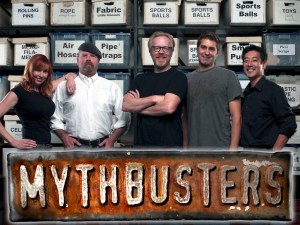
Mythbusters (2003-present) This program employs physics, mathematics, robotics, history, and explosions to explore urban myths, movie special effects, and events in history.
USAT says: This is hands-down one of our favorite shows of all time. The hosts are great and accessible, the content is really fun to explore, and they do a good job of explaining their scientific methodology and math in a way that makes sense. It is pitched at a level that is very kid-friendly.
Airs: The show will return in 2016 to the Discovery Channel for its final season, but in the meantime you can watch clips and some full episodes on their website or purchase episodes on Amazon streaming.
 Particle Fever (2013) “For the first time, a film gives audiences a front row seat to a significant and inspiring scientific breakthrough as it happens. Particle Fever follows six brilliant scientists during the launch of the Large Hadron Collider, marking the start-up of the biggest and most expensive experiment in the history of the planet, pushing the edge of human innovation.”
USAT says: You don’t have to be a physicist to appreciate this easy to swallow peek into the power of the smallest unit, the particle. It is really cool to see so many people coming together to make the world’s largest science experiment.
Airs: You can download it through the website for $14.99 or watch it on Netflix streaming.
Getting kids excited about Science, Technology, Engineering, and Math can take many forms. They get a certain type of exposure to these subjects in school, but museums also offer great opportunities to explore these principles in a different setting and on a different scale. When kids interact with objects, be they the original things or exhibits that present their mechanisms, they can’t help but learn by doing. And these are the experiences that adults still remember long after their middle school years have passed. (If you would like to learn more about the impact of science centers on learning and personal growth, you should check out this meta study.)
In Minnesota alone there are several science and technology-based museums. The Bell Museum of Natural History on the University of Minnesota campus, for instance, is a place for kids to learn about animals through dioramas and hands-on exploration of fossils. The Mill City Museum explores the history of industry on the Mississippi waterfront. You have probably never heard of the Bakken Museum, but it is a unique way to discover the power and uses of electricity and magnetism. The Works Museum in Bloomington is dedicated to the inner workings of machines and engineering, and the Minnesota Transportation Museum in St Paul is dedicated to the technology of getting from point A to point B. Of course, there is always the Science Museum of Minnesota as well.
“I would definitely say that the Science Museum of Minnesota (SMM) played a big role in my interest in science later in life. I had a great time visiting both the old building and the renovated one, so when I was looking for an out-of-the-box job for my final year of undergrad the SMM seemed like a perfect fit. I not only got to work in the Collections Department and the Big Backyard, but took some of the free classes they offered. I will never forget when I was first introduced to the concept of computer coding by learning how to write a simple program that turned LED lights on and off in the order I wanted. It turns out that coding is both easy and fun, and now there are so many different applications across diverse platforms. The possibilities for expanding this kind of technology are endless.”
~Alison Weaverdyck, Creative Director
And the best part is that the SMM still offers a variety of free classes for kids of all ages! This weekend the fabulous staff, as well as female scientists from around the state, will be celebrating women in science with their “Girls, Science and Technology” day. The demonstrations below are included in the admission price, but for one day only museum patrons can get FREE admission for up to four kids with the purchase of one adult ticket. Find out more on their website (link to embed: https://www.smm.org/girls-science-and-technology).
On Saturday, November 14 from 10-4 you are invited to:
Looking to infuse your USAT practice with a little technology but don’t have time to take a field trip to a museum? Here are a few brainstorming and project ideas to get your triathletes in the right mindset.
 usacademictriathlon.com